


Contact us at
hello@thenerve.co


Lies and hate dominate posts about the Lifeline Rate Subsidy, which is designed to help the marginalized and has a minuscule impact on consumers
As customers of the Manila Electric Company (Meralco) ran to social media to express outrage over higher electric bills in April, taking most of the blame is the Lifeline Rate Subsidy Program (LRSP).
The LRSP, which took effect in April 2026, provides up to 100% discounts in electricity to beneficiaries of the Pantawid sa Pamilyang Pilipino program (4Ps) and qualified marginalized customers. [READ: What’s behind the ‘subsidy’ charges in your electricity bill?]
To subsidize the program, overall consumers are charged with a Lifeline Rate of P0.01/kWh. Meanwhile, Meralco also increased its generation charge to P8.3864/kWh as of April.
However, viral posts about the issue online — mostly by content creators with huge followings — zeroed in on the Lifeline Rate Subsidy and the 4Ps beneficiaries. Lies and hate dominated the posts.
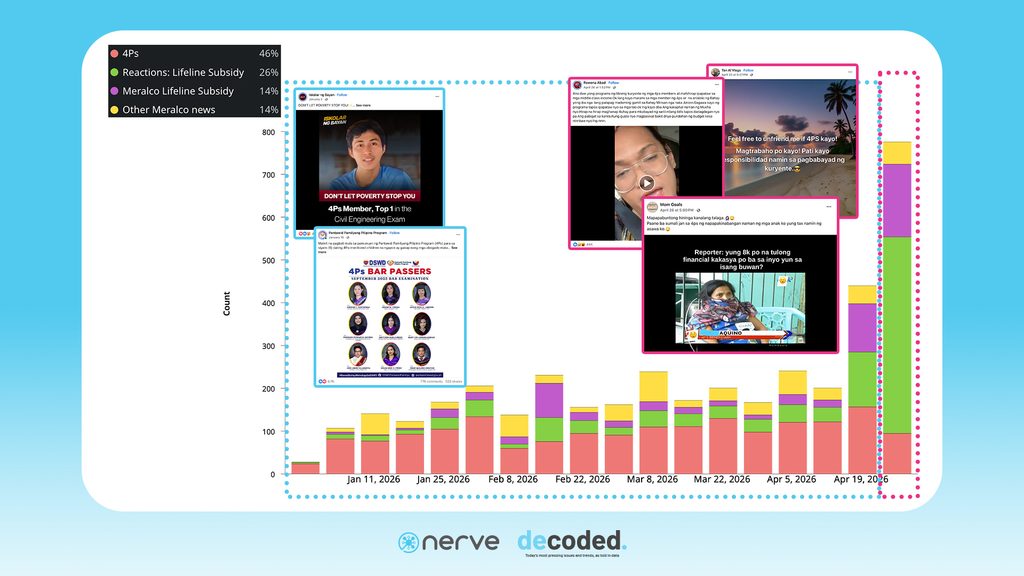
Data forensics group The Nerve looked into public Facebook posts related to the issue of higher electricity bills posted since the start of the year — and around 26% of the posts were reacting to the program. They surged during the week of April 26, around the time when the Lifeline Rate Subsidy was charged to consumers.
Most of these reactions were negative, saying that the Lifeline Rate caused the spikes in electric bills, even when it actually constitutes a miniscule percentage of the total charges.
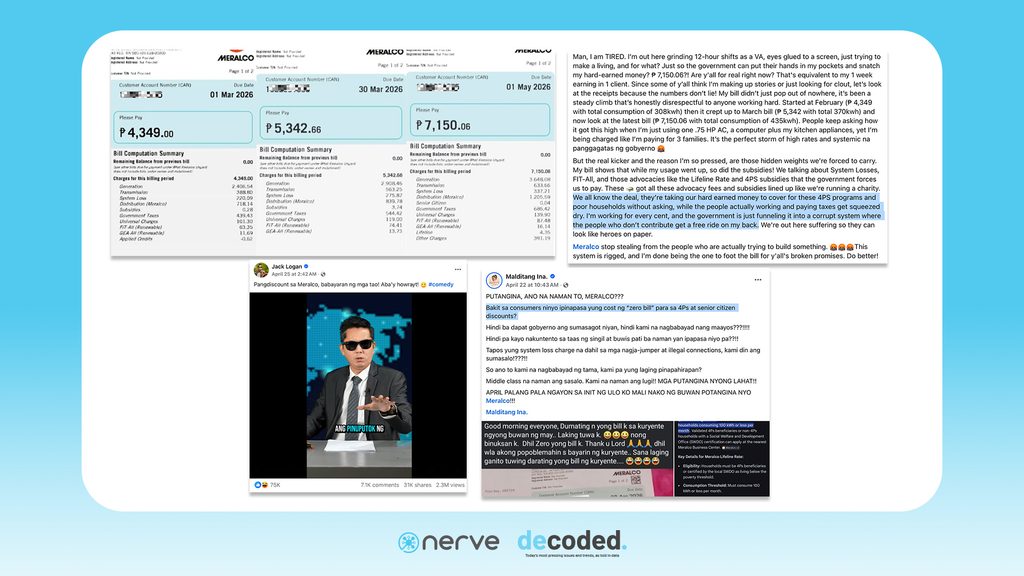
In one Facebook post, a Meralco customer provided snapshots of their bills due for March to May, pinning the blame on subsidies for 4P beneficiaries, which the Lifeline Rate provides. However, the bills showed hundreds of pesos added for generational charge, among others, and only less than five pesos added for the Lifeline Rate Subsidy.
The Facebook post still got more than 5,700 reactions and 2,800 shares. Other viral posts wrongly attributed the increase in electric bills to the Lifeline Rate, getting as much as 71,000 reactions and 30,000 shares.
With the LRSP getting the blame for increased electric bills, 4Ps recipients — who benefit from the subsidy — catch some of the blame, too.
But what is the 4Ps, exactly?
It’s a government program that aims to reduce poverty in the country by providing cash grants to qualified households under a set of conditions. Most of the beneficiaries come from impoverished communities.
There have been numerous success stories about 4Ps beneficiaries topping board exams, passing the Bar, becoming teachers, and others. These stories have been consistently shared online before the LRSP issue came to light.
However, by the last week of April, discriminatory and stigmatizing content against 4Ps beneficiaries took over. Several of these posts regarded the beneficiaries as freeloaders taking advantage of taxpayers.
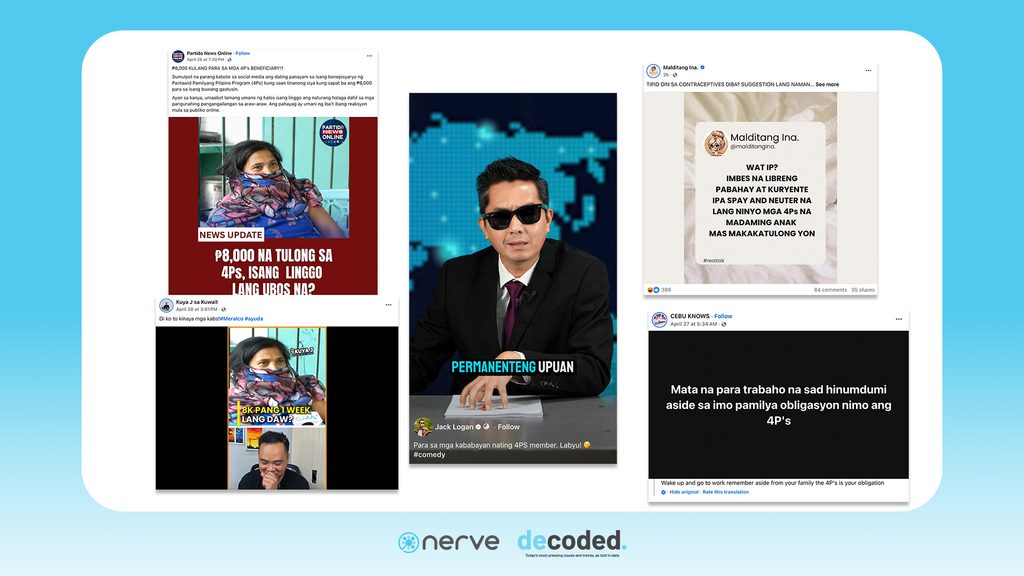
Some of these posts spread outright disinformation.
A video from Facebook creator Jack Logan on April 30, for instance, falsely accused 4Ps beneficiaries of being permanent recipients of support from the government. Beneficiaries graduate from the program when they reach certain milestones and/or when they’ve reached a duration of seven years.
Several Facebook posts during the week of April 26 were also found to have reposted a video interview with a 4Ps beneficiary, where users mocked the beneficiary who found the P8,000 in government financial aid insufficient for a week’s worth of expenses. What was omitted from the reposts was the fact that the interview was from April 2020, during the COVID-19 pandemic, and that the beneficiary was budgeting the P8,000 aid for eight people.
Top-shared anti-4Ps posts got higher average engagements compared to factual 4Ps content, despite the latter having more posts in the overall timeframe.
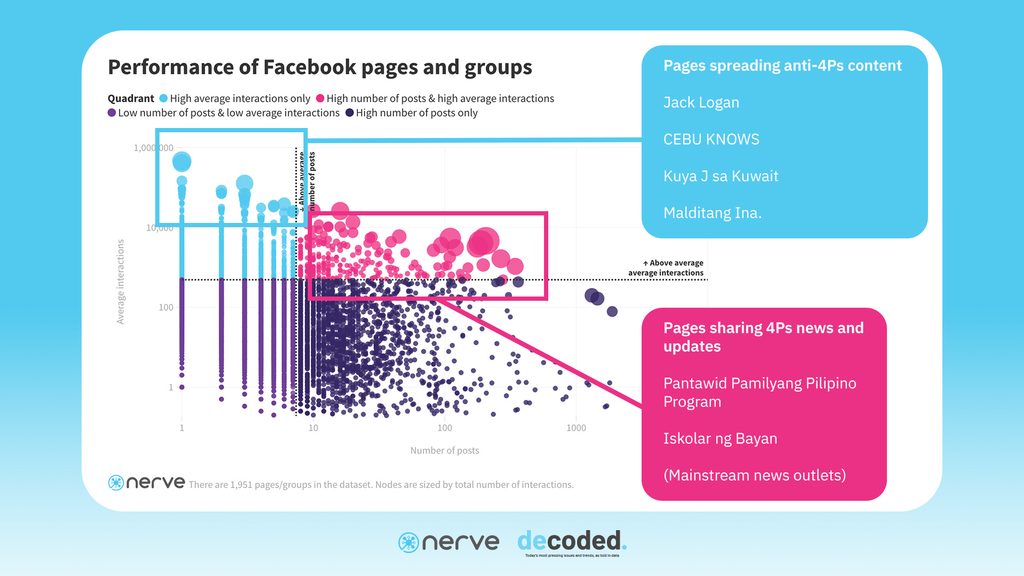
Philippine content creators on Facebook can earn from P5,000 to P50,000 from Reels alone, according to digital marketing estimates. With lies spreading six times faster than the truth, creators would be incentivized to produce the former.
So little has been done to address this, either. While measures from social media platforms lag, online harms have crossed over offline, fueling harassment and leading to shootings.
Meralco recently increased its generational charge, which takes up most of the total electric charges, from P7.8607/kWh to P8.3864/kWh in April. The electric company attributed the increase to the weakening of the Philippine peso against the US dollar amid the conflict in the Middle East.
Electric consumption also spikes during the warm and dry months from April to June, according to Department of Energy data.
Meanwhile, the LRSP is mandated by Republic Act No. 9136 or the Electric Power Industry Reform Act of 2001. Republic Act No. 11552, signed in 2021, extended the subsidy to 4Ps beneficiaries.
While both laws established the LRSP and 4Ps beneficiaries as their recipients, it was a 2026 resolution by the Energy Regulatory Commission that established additional charges to consumers to fund the program.
– with reports from Pauline Macaraeg/Rappler.com
This story was originally published on Rappler on May 5, 2026.
Decoded is a Rappler series that tackles Big Tech not just as a system of abstract infrastructure or policy levers, but as something that directly shapes human experiences. It is produced by The Nerve, a data forensics company that enables changemakers to navigate real-world trends and issues through narrative and network investigations. Taking the best of human and machine, we enable partners to unlock powerful insights that shape informed decisions. Composed of a team of data scientists, strategists, award-winning storytellers, and designers, the company is on a mission to deliver data with real-world impact.


