


Contact us at
hello@thenerve.co

In a new study, The Nerve documents the systematic importation of the authoritarian playbook and how the 'Deconstruction Model' turned narrative warfare into kinetic reality
The following is the preface written by Nobel Peace Prize laureate Maria Ressa for this study.
NEW YORK, United States — When we founded The Nerve, it was with a certainty born from experience: we had already lived through the future of information warfare, and we knew it was heading West. In the Philippines under Rodrigo Duterte, we watched a leader weaponize social media to bypass traditional institutions, creating a parallel reality where journalists and critics were branded “enemies of the people”, and facts became meaningless.
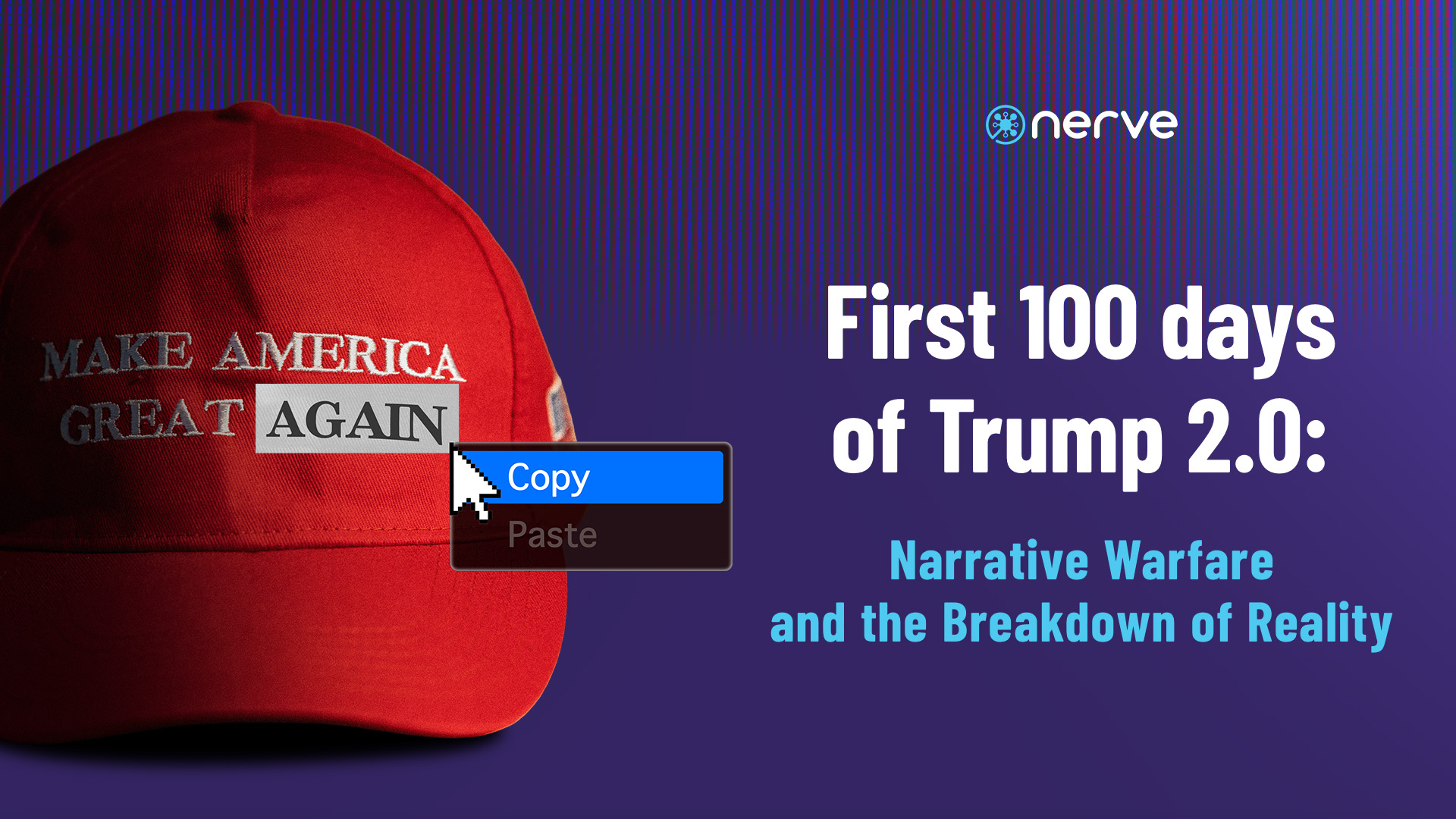
When we analyzed the first 100 days of Donald Trump’s second term, we recognized the warning signs immediately. The chaos of those early months – 143 executive orders in the first 100 days triggering the further fragmentation of the public square – was not just political turbulence. It was the systematic importation and evolution of the authoritarian playbook we survived in the Philippines.
This report, originally compiled in the spring of 2025, documents the installation of that machinery. But what we observe in the United States is more sophisticated than what we fought in the Global South.
Where the Duterte model relied on paid trolls and coordinated behavior, the Trump 2.0 model – which we termed the “Deconstruction Model” – achieved something more insidious: it made the fragmentation self-sustaining. By leveraging the “creator economy” and algorithmic incentives, the administration created a closed feedback loop where the breakdown of reality was fueled not just by the state, but by a decentralized army of influencers monetizing outrage. This was enabled by a massive structural shift: the fusion of state power and the tech “broligarchy,” allowing the roll-back of safety measures and Big Tech’s worst instincts for profit and power.
Our research identifies a three-stage funnel: narrative warfare fragments shared reality, enabling institutional dismantling, which clears the path for kleptocracy. This model does not require majority support; it only needs a fragmented opposition and a governing coalition that powers ahead.
One year ago today, Donald Trump was inaugurated for his second term. In twelve months, his administration signed 225 executive orders – more than in all four years of his first term combined. The Department of Government Efficiency, led by Elon Musk until May, produced the largest peacetime workforce reduction on record: 271,000 federal jobs eliminated, a 9% decline in under ten months. DOGE failed to cut spending; in fact, spending increased to $248 billion. The operation dismantled institutional capacity: USAID eliminated; the IRS gutted; inspectors general replaced with loyalists; whistleblower protections weakened.
Immigration enforcement scaled to industrial proportion. ICE signed over 1,300 agreements with local law enforcement – up from 135 a year earlier – and diverted 25,000 officers from regular duties. Internal documents describe “processing sites” and “warehouses” to speed deportations, efficient “like Prime but with human beings.” Nearly 74 percent of detainees have no criminal convictions.
The administration went to war with the judiciary – evading court orders, suing judges, filing misconduct complaints. Vice President JD Vance declared that “judges aren’t allowed to control the executive’s legitimate power.” A senior DOJ official allegedly told attorneys to “consider telling the courts ‘fuck you’”; he was subsequently confirmed to a federal appellate judgeship.
We release this analysis now because the endgame we predicted has arrived – not as policy, but as military action, occupation, and bloodshed.
On January 3, 2026, the United States invaded Venezuela, captured President Nicolas Maduro in a nighttime Delta Force raid, and announced it would “run the country” while American companies extracted its oil. The operation was conducted without congressional authorization; War Powers resolutions had failed narrowly after the administration assured lawmakers it had no attack plans. Hours after announcing Maduro’s capture, President Trump declared: “We want the oil back.”
This is what narrative warfare enables. The infrastructure we documented in the first 100 days – fentanyl designated a “Weapon of Mass Destruction,” cartels labeled Foreign Terrorist Organizations, Venezuela framed as existential threat - was not just rhetoric. It was the scaffolding for kinetic action. The narrative framing that began as Facebook memes had been activated for military intervention.
Four days later, on January 7, ICE agent Jonathan Ross shot and killed Renee Good, a 37-year-old American citizen and mother of three, on a residential street in Minneapolis – what the Department of Homeland Security called its “largest immigration enforcement operation ever.” Video footage showed her steering wheel turning away from the agent when he opened fire. Six federal prosecutors in Minnesota resigned in protest after the Justice Department refused to investigate the shooter and its push to investigate Good’s widow instead.
As we finalize this report, 1,500 active-duty soldiers from the Army’s 11th Airborne Division are on standby for possible deployment to Minnesota. Trump has threatened to invoke the Insurrection Act against American citizens protesting the killing of an American citizen. And horribly reminiscent for Filipinos – the US Justice Department opened investigations into Governor Tim Walz and Mayor Jacob Frey, accused of “terrorism.”
Simultaneously, Trump has announced tariffs on eight European allies until they agree to cede Greenland to American control. “We are going to do something on Greenland whether they like it or not,” he told reporters. “If we don’t do it the easy way, we’re going to do it the hard way.” Denmark’s Prime Minister warned that any use of force against the NATO ally would destroy the postwar alliance. (Only 6% of Greenlanders support joining the United States.)
Sixty-three percent of Americans opposed military action in Venezuela. Seventy-four percent said the president needed congressional authorization. Sixty-one percent now say ICE is being “too tough.” None of it mattered. The Deconstruction Model succeeded: it fragmented shared reality so completely that majority opposition could not prevent – nor hold anyone accountable – for these actions.
German MP Roderich Kiesewetter named the stakes: “The U.S. are [sic] abandoning the rules-based order that has shaped us since 1945 … a mindset where the law of force rules, not international law.” Russia and China immediately invoked Venezuela to justify their own territorial ambitions.
We publish this retrospective to name the dynamics that brought us to where we are today. We did this research not to take a partisan position, but to expose the forces shaping our collective reality. Having lived through the collapse of an information ecosystem before, we know that understanding the mechanism is the first step to resisting it.
The first 100 days formed the blueprint. Venezuela is the proof. Minneapolis is the warning. Greenland is the pattern. This report is the evidence of how narrative warfare laid the groundwork – and what becomes possible when the battle for information integrity is lost.
In the Philippines, we learned that fighting for facts is fighting for democracy itself. In America, one year into this new reality, that battle is no longer theoretical – it is the defining struggle of our time.
The window for journalism has narrowed faster than we predicted. Democracy’s window has narrowed with it. What follows is both documentation of the machinery and a call to action for citizens who refuse to accept that this is how the story ends.
Maria A. Ressa
Nobel Peace Prize Laureate, 2021
CEO, Rappler and Head of Global Strategy, The Nerve
Professor of Practice, IGP Faculty Advisory Board Member, and IGP Technology & Democracy CoDirector, Columbia-SIPA
In a new study, The Nerve documents the systematic importation of the authoritarian playbook and how the 'Deconstruction Model' turned narrative warfare into kinetic reality

